

Why Progressive Strength Training Should be Your Trump Card
There are plenty of ways to move your body, but if you had to choose one form of training to prioritize for the long haul, Alyssa Parten, PhD, makes a strong case for progressive strength training.
Alyssa Parten, who has a PhD in exercise science with a focus on resistance training strategies for women’s long-term health and performance, first picked up weights as an undergraduate student at the University of Alabama almost 15 years ago. Since then, she has competed and coached at the national and international levels in the sport of powerlifting – a strength sport where athletes lift the most resistance they can in a barbell back squat, bench press, and deadlift. For nearly 15 years, Alyssa has focused her professional and academic career on teaching women how to resistance train to transform their physique, their health, and their mentality surrounding exercise.
The Difference Between Resistance Training and Strength Training
- Resistance exercises are considered any movement where your muscles work against resistance (known as external load) during joint actions. This added resistance forces your muscles to work harder than they normally would to move or control a load. Examples of external load include dumbbells, barbells, machines, cables, kettlebells, and resistance bands.
- Strength training falls under the umbrella of resistance training, but with a focus on moving heavier resistances that are closer in proximity to your maximal force capacity. Strength itself is the ability to move the heaviest resistance you can through the range of motion of an exercise one time. The further you get from one heavy repetition the less maximal strength or force is required. Strength is a neuromuscular skill, meaning it requires the brain to communicate with your muscles to contract quickly and forcefully, and we typically train this skill within 1-6 repetitions per set of an exercise.
What Does Strength Training Do to Transform Your Body and Health?
Strength training became the anchor of my routine. At first, I approached it with a single goal: physical change. But over time, the benefits extended far beyond appearance. I felt stronger, more capable, and more connected to what my body could do, rather than how it looked.
- Strength training is effective for building and maintaining both muscle mass and neuromuscular coordination. Without resistance training, you lose 1-3% of muscle per decade after 30, which increases to 6% or higher after the age of 60! Not only does muscle mass loss put you at risk of sarcopenia and osteoporosis, it also is the main reason we see unfavorable body composition changes as we age – not hormone changes.
- Strength training improves bone density and joint stability. When we add resistance to our body when performing exercises like squats, deadlifts, rows, and presses, we not only stimulate our muscles to grow, but for our bones to remodel. This is imperative in helping prevent bone fractures and breaks as we age and maintain our physical independence.
- Strength training supports heart and metabolic health. Consistent strength training makes our heart pump blood more efficiently, lowers resting blood pressure, reduces risk of atherosclerosis (plaque in arteries) and high cholesterol, decreases blood sugar and increases insulin sensitivity. A lot of big words – but all this to say, strength training improves cardiovascular health, weight management, metabolic rate (i.e., metabolism), and insulin resistance.
- Strength training helps maintain independence with age and decrease risk of virtually all chronic diseases – obesity, type II diabetes, sarcopenia, osteoporosis, cardiovascular disease, and Alzheimer’s disease.
3 Common Myths With Strength Training
1) “Strength training will make women bulky.”
Strength training in and of itself is a skill, one that involved your brain talking to your muscle to contract very quickly to overcome a heavy resistance. In fact, studies show that you can substantially increase strength without large increases in muscle mass. Simply put, getting stronger does not automatically mean getting bigger.
The reality is, building large amounts of muscle takes years of very consistent specialized training and nutrition. Most women develop muscle strength, muscle tone, and improved body composition, on top of the numerous health benefits.
2) “Cardio is better for fat loss.”
Strength training supports muscle mass, metabolic health, and resting energy expenditure, making it an extremely effective tool for lowering body fat percentage and improving body composition (higher fat free mass and lower fat mass). Studies have also consistently shown that higher intensity forms of exercise increases fat burning for longer durations of time than low intensity cardio. Just because you may use fat as a fuel source during low intensity bouts of exercise, does not mean you continue burning fat afterwards.
3) “You have to lift heavy to build muscle.”
Research is clear that you can build muscle with virtually any resistance and repetition ranges – the true key is to challenge your muscles limits in the exercise being performed to stimulate muscle development. This means building muscle can be achieved with heavy weights done for a low number of repetitions if that is your preference, or lighter weights performed for a higher number of repetitions.
Whatever your preference, do the exercise for as many repetitions as you need, to feel muscle fatigue.
Tips for Starting a Strength Training Program
- Start simple and focus on consistency over perfection. By this I mean, do movements that resemble activities of daily living (squat, push, pull, hinge/pick-up), that focus on main muscle groups (legs, chest, back).
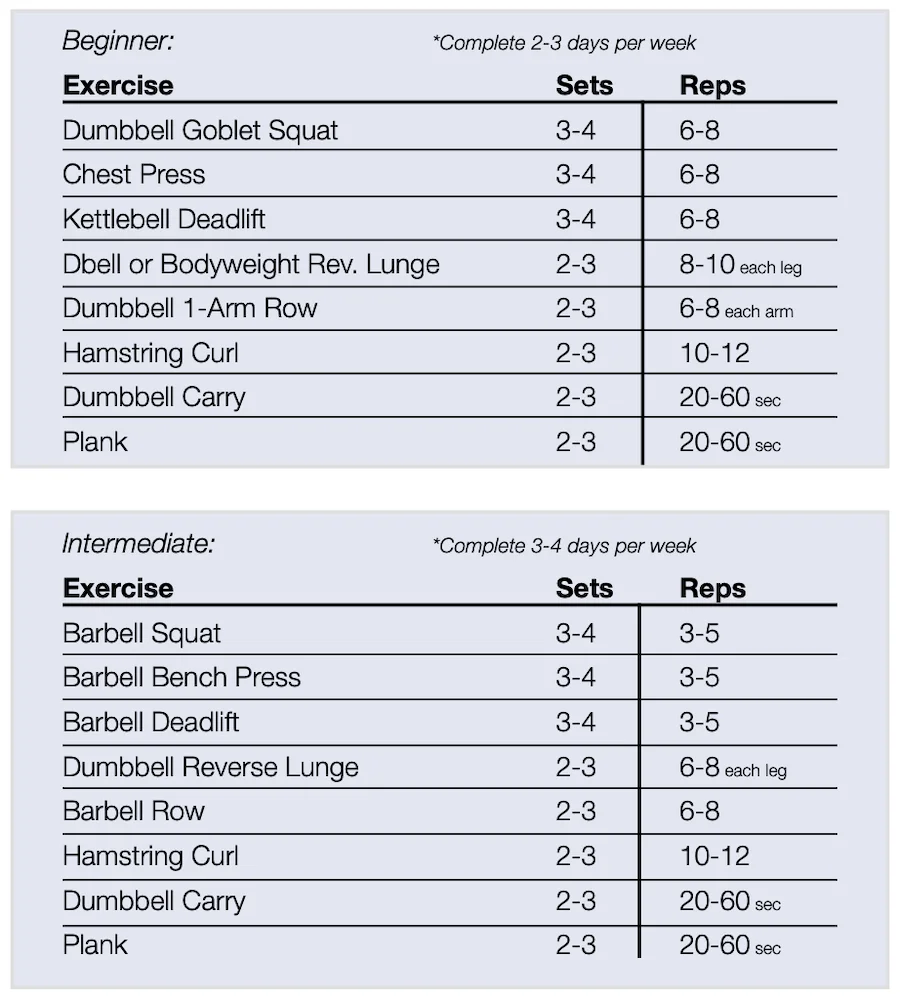
- Begin with 2-3 sessions per week with 1-2 days off from resistance exercise in between. After you have been consistent with this for a while, if your schedule allows for it, you can increase to 3-4 days per week.
- The basics work now and always! Build your resistance training sessions around the “Big 5”: squat, press, hinge, pull, carry. Doing so targets the major muscle groups that build your physique and keeps your body functional long term. Think of these exercises as the biggest bang for your buck that never grow stale or quit working, as long as you progress resistance or capacity as you adapt to them. See the sample program below.
- Use a resistance that allows you to challenge your muscles in the movements performed but is still controllable – meaning you don’t feel yourself compensating the movement in order to lift the weight chosen.
- Our bodies are built to adapt, and therefore we must continue to challenge them in order to see the improvements we are aiming for. To continue seeing adaptations to our body and health, we have to progress our training gradually over time. See options to progress your resistance training from ‘How to Progress Your Training’ below.
How to Progress Your Training
1. Repetitions
Increase repetitions by 1–2 each week as able while maintaining good form.
2. Sets
Add 1 additional set (ex: from 2 sets to 3 sets) as your strength and capacity improves.
3. Load
Gradually increase the amount of weight or resistance used by about 2.5–5 lbs when your current load feels manageable with proper form.
4. Frequency
Increase training frequency from 2 days/week up to 3–4 days/week over time as tolerated and schedule allows.
Considerations
- Choose just ONE progression method per exercise each week.
- Keep the same workout and exercise variations for about 3 weeks before changing the exercise variation. (Can look up different variations on YouTube).
- Then restart the example program with the new variations but with similar sets and reps and continue progressing gradually each week.
Strength for the Long Run
The appeal of strength training is not just what it can change in the mirror. It is what it can help preserve over time: muscle, mobility, confidence, capacity and independence.
For more Birmingham wellness, fitness and lifestyle stories, sign up for the About Town email and stay connected to what’s happening around town.